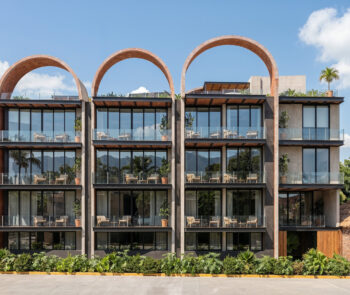
Lock-Offs in Vallarta · Nayarit: The Evolution of the Concept in the Region’s Real Estate Market
During the last decade, the Vallarta · Nayarit real estate market has undergone a transformation driven by new buyer profiles. In this context, lock-off units have positioned themselves as one of the most relevant residential configurations in the region. Their growth responds to new consumer dynamics, shifts in property demand, the vacation rental boom, and the need to balance investment with profitability.
For Sergio Torres, commercial director of Geographica (the development firm behind 105º Midtown, a project featuring lock-off units currently under construction in Puerto Vallarta’s Aralias neighborhood), this phenomenon clearly reflects the moment the destination is experiencing: “Today we have buyers who are much more informed, educated, and prepared to compare options before making a decision,” he explains. This transformation, he asserts, has forced developers to rethink the type of product they offer and the way they design their projects.

A MARKET DICTATED BY THE BUYER
Following a period where demand vastly outpaced real estate supply, the market evolved into a much more competitive arena, with a greater number of projects seeking to capture the attention of an increasingly selective buyer.
That shift altered the rules of the game for developers, brokers, and investors alike. Differentiation ceased to depend solely on location or traditional amenities, centering instead on factors such as functionality, housing flexibility, and return on investment potential.
“The pandemic accelerated this transition. Remote work, extended stays, and hybrid mobility triggered new residential needs, particularly among international buyers seeking properties capable of combining a primary residence, a temporary office, and a rental asset within the same space,” he notes.
Consequently, residential developments began incorporating amenities designed for more holistic lifestyles: coworking areas, gyms, social spaces, panoramic rooftops, and multifunctional configurations that cater to different user profiles. The traditional vacation condo evolved into a much more adaptable product.

Sergio Torres, commercial director of Geographica.
THE RISE OF THE LOCK-OFF MODEL
Within this transformation, lock-off units found fertile ground to grow. Although the concept has existed for some time in international tourist destinations, its adoption in Puerto Vallarta has gained significant momentum over the last five years.
In practical terms, a lock-off unit consists of a condominium designed with two independent entrances that allow the property to be divided into autonomous spaces. Generally, one section integrates the kitchen, living room, dining room, and a primary bedroom, while the other functions as an independent studio apartment with its own entrance.
The primary advantage lies in its operational versatility. The owner can occupy the entire unit, rent out just one section, or market both spaces independently under short- and/or long-term rental schemes.
“Lock-off units allow a single property to be operated as two independent apartments. This model is particularly attractive to investors looking to diversify risks and optimize income within a market where vacation rentals maintain steady demand throughout most of the year,” says Torres.
FROM EMOTIONAL BUYER TO STRATEGIC INVESTOR
Another prominent shift within the regional real estate market is the evolution of the buyer profile. A decade ago, a large portion of acquisitions in Puerto Vallarta responded to decisions associated with retirement, vacation, or lifestyle. Today, the financial approach carries significantly more weight.
Contemporary buyers view real estate as long-term wealth-building vehicles. They look for capital appreciation, but also for operational cash flow, annual yields, and the ability to adapt to different economic scenarios.
According to Torres, today’s buyer “invests to increase assets,” which has created greater market segmentation and a considerably higher level of scrutiny regarding project design, location, and quality.
This has caused concepts such as residential multifunctionality and square-footage optimization to become determining factors in the decision-making process.
Today, an investor does not merely evaluate finishes or amenities; they analyze potential occupancy, operational efficiency, and the capacity to generate revenue under various models.
In this manner, lock-offs offer a clear competitive advantage over traditional layouts. While a conventional condo relies on a single occupancy model, a lock-off unit allows strategies to be adjusted as market conditions or the owner’s personal needs change.

RESIDENTIAL DESIGN FOR A NEW GENERATION
The market’s evolution has also modified how residential developments are conceived. Architectural design no longer responds exclusively to aesthetic criteria, but rather to parameters closely linked to user experience.
Torres believes that current generations of buyers demand projects capable of integrating into multifaceted lifestyles. Because of this, amenities have stopped being recreational add-ons and have become functional extensions of the residence.
“Ten years ago, offering a pool and a terrace was enough,” he comments. “Today, the client looks for spaces that improve their daily life as well as their relaxation experience.” That transition has elevated the importance of concepts like smart design, connectivity, privacy, and spatial efficiency. Even within developments incorporating compact units, the market continues to value spaciousness and proper interior layout.
ADAPT OR LOSE COMPETITIVENESS
In a destination with the dynamism of Vallarta · Nayarit, adaptability has become one of the main challenges for developers. Market preferences shift rapidly, and real estate cycles demand agile responses even during advanced stages of construction.
Torres acknowledges that reacting late can significantly limit the possibilities for adjustment due to structural, regulatory, and operational challenges. Therefore, he considers it indispensable to conduct much deeper market research from the earliest phases of planning.
Likewise, trust and certainty have become fundamental assets within the real estate market. Facing a more informed buyer, aspects such as compliance and construction quality carry increasing weight: “The client wants the peace of mind of knowing that they will receive exactly what was promised.”
THE NEXT STAGE OF THE MARKET
“I believe that over the coming years, lock-off units will continue expanding their presence within Puerto Vallarta and Riviera Nayarit. However, the market also seems to be heading toward a more mature and sophisticated stage, where competition will force an elevation of design, construction, and residential experience standards,” Torres concludes.
The sector’s evolution will not depend solely on building more, but on developing products better adapted to a reality where investment, lifestyle, and functionality converge into a single wealth-management decision.